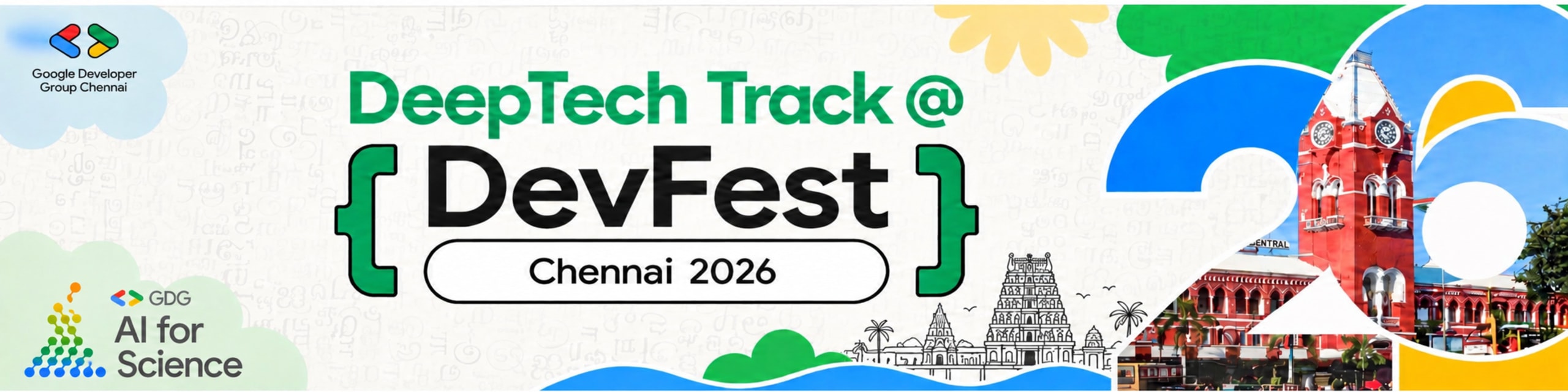
Join us for the DeepTech Track at DevFest Chennai 2026 to explore how frontier AI and scientific research are shaping safer robotics, smarter healthcare, materials discovery, and real-world infrastructure.
0 RSVP'd
DeepTech Track @ DevFest Chennai 2026 brings together developers, researchers, and innovators exploring the frontiers of AI, science, robotics, healthcare, and emerging technologies.
Organised by GDG AI for Science India in partnership with GDG Chennai, the track explores how cutting-edge research translates into real-world applications through expert talks, technical sessions, and hands-on learning.
Join us to exchange ideas, explore new possibilities, and discover how we can build technology that makes a difference.
📅 Date: 17 October 2026
🕘 Time: 9:00 AM – 5:30 PM
📍 Venue: IIT Madras Research Park
🎤 Location: D7 Amphitheater
🔗 Explore the event: https://devfest.gdgchennai.in/
🎟️ Register: https://konfhub.com/checkout/devfest-2026-chennai
Air pollution is not just a problem of measurement; it is a challenge of identifying sources, enabling timely enforcement, and determining whether interventions actually improve air quality. Using Chennai as a context, this session explores how AI and digital technologies can help bridge the gap between environmental data and effective public action.
Beginning with the fundamentals of air pollution, its health and economic impacts, and the strengths and limitations of the Air Quality Index (AQI), the talk examines two applications in depth: data-driven tracking and localised mapping to identify construction dust and dispersed pollution hotspots, remote sensing, automated detection, and data-enabled enforcement to address vehicular emissions. The session challenges developers to look beyond dashboards and prediction models towards building practical, action-oriented tools that help cities tackle pollution.
As AI agents and robots move from controlled laboratories into homes and workplaces, ensuring their safety and reliability becomes increasingly complex. Conventional benchmarks often fail to capture what a system can safely do for a particular user in a specific environment. This talk explores a more human-centred approach to evaluating physical AI: making system capabilities interpretable, identifying limitations, and assessing safety in real-world contexts. Drawing on research in interpretable capability models, LLM-based planning, and personal robotics, the session examines how developers and scientists can build AI systems that are not only capable, but also reliable, safe, and compatible with human needs.
How can AI make water and sewer pipeline inspections faster, more consistent, and data-driven? This session explores how computer vision and object detection models can identify and classify pipeline defects from inspection videos, supporting more efficient infrastructure assessment.
The talk will walk through the end-to-end AI pipeline, from video acquisition and preprocessing to dataset preparation, model training, inference, evaluation, and inspection reporting. It will also address practical challenges such as variations in lighting and video quality, diverse defect appearances, class imbalance, and reliable detection across different pipeline conditions. Finally, the session will examine how automated defect detection can be integrated into real-world inspection workflows to support infrastructure monitoring and assessment.
What happens when malware is treated as an image, or the subtle statistical patterns in synthetic images become clues to detecting deepfakes? In this talk, Dr. Lakshmanan Nataraj explores two unconventional approaches to applied AI: visualising binary executables for malware classification and identifying GAN-generated images through statistical and co-occurrence patterns.
Drawing on these case studies, he examines how novel research ideas can evolve into publications, patents, operational systems, and real-world applications. The session also explores strategies for identifying promising research directions, translating scientific insights into intellectual property, and bridging the gap between laboratory research and deployment, concluding with perspectives from his recent involvement in AI for Science initiatives.
From precision medicine to immersive clinical training, artificial intelligence and virtual reality are reshaping how healthcare is delivered and learned. This talk explores how AI is being used in clinical settings, how VR is transforming medical education to prepare the next generation of clinicians, and how immersive experiences are helping educate patients and manage pain in select clinical settings. Drawing on work at MediSim VR, the session will offer a glimpse into the emerging role of these technologies in healthcare.
Applying AI to the physical sciences requires more than learning patterns from data. Scientific datasets can be limited in scope, physical laws impose constraints beyond observed examples, and real-world systems often behave differently from the data on which models are trained. This session explores these challenges through applications in structure–property prediction and materials discovery, surveying approaches ranging from random forests and neural networks to graph neural networks, physics-informed models, and large language models. It will also examine the distinction between predicting outcomes and uncovering the mechanisms behind them.
The hands-on workshop will introduce practical AI methods for scientific applications through browser-based tutorials, covering physics-informed neural networks (PINNs), graph neural networks (GNNs) for molecular property prediction, and machine-learning interatomic potentials.
DevFests are one of the largest and most inclusive community-led technology conferences worldwide! Every year, Google Developer Groups host DevFests, where attendees explore developer tools, learn from Google Developer Experts, and connect with other tech enthusiasts from their local community.
At DevFest Chennai, we are proud to embrace researchers, engineers, designers, leaders, entrepreneurs and students across cities with diverse backgrounds. This is the time of the year when our community comes together to learn from each other and share their wisdom and projects through talks, panel discussions, showcases and more. The conference is a great opportunity for attendees to meet like-minded people and collaborate to learn, build and contribute to the wider ecosystem.

Saturday, October 17, 2026
3:30 AM – 12:00 PM (UTC)
Ocean Energy Pathway (OEP)
Program Associate, India Team
Solinas Integrity
AI Team Lead
IIT Madras
Assistant Professor
IIT Madras
Assistant Professor
AI Researcher and Consultant
MediSim VR
Strategic Partnerships Manager
Gen Digital
SDE| Product Developer | AI Enthusiast
GDG AI for Science
Organizer
Freshworks
Staff Security Engineer


